
October 27, 2026
How to Prepare for a Call Center Interview, A Complete Guide
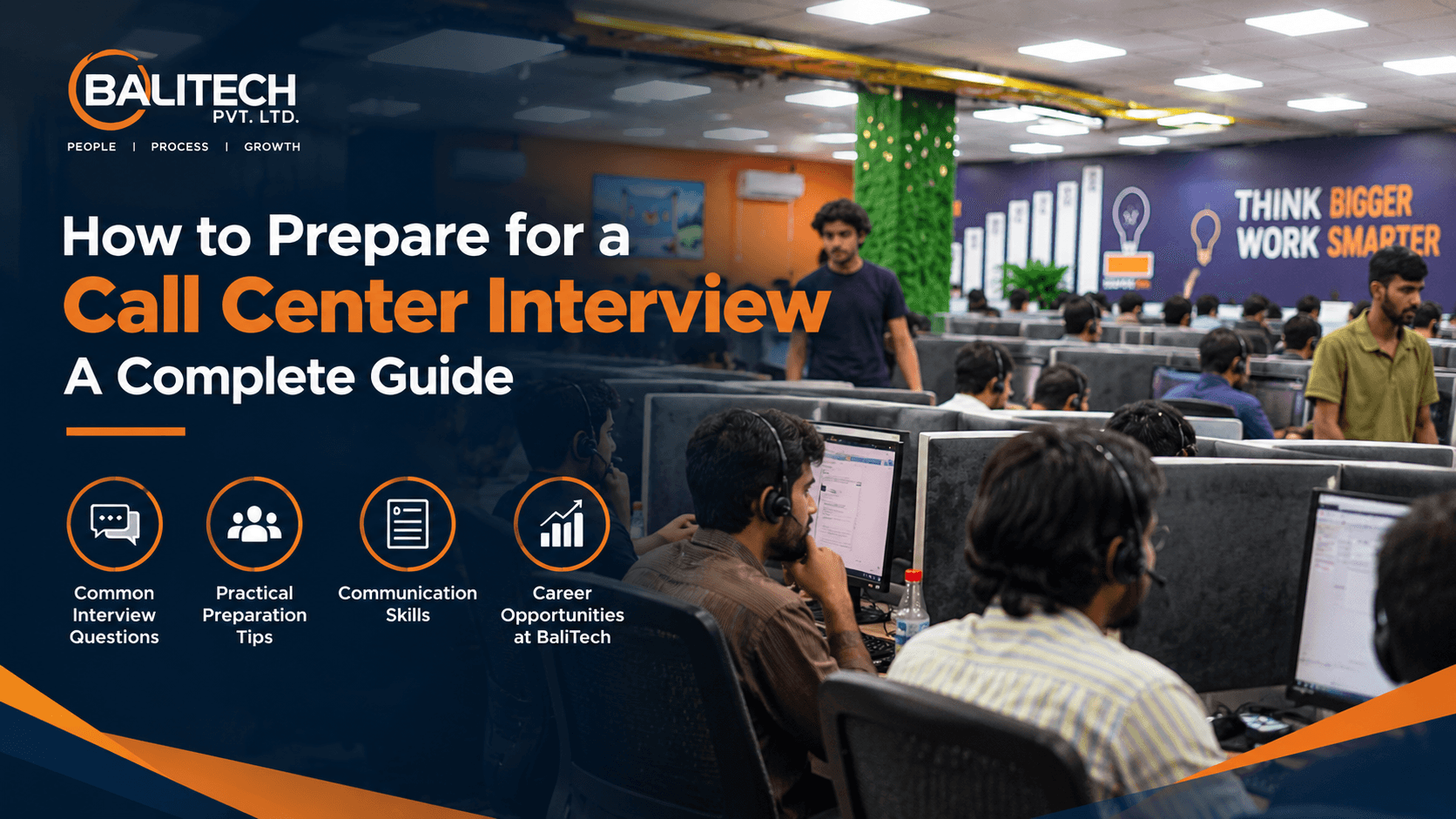
Preparing for a call center interview? Learn how to introduce yourself, answer common interview questions, improve your communication, and understand what employers expect from freshers and experienced candidates.
Preparing for a call center interview can feel challenging, especially when you are applying for your first job or have never worked in a professional calling environment. You may be wondering what questions the interviewer will ask, whether your English is good enough, how to introduce yourself, or what to say when you have no previous experience. These are common concerns, and understanding what employers actually look for can make the preparation process much easier.
A good call center interview is not simply about speaking fluent English or memorizing impressive answers. Employers also want to understand how you listen, communicate, handle different situations, follow instructions, and approach your responsibilities. Whether you are applying for customer support, outbound sales, verification, or another BPO position, this guide will help you understand common call center interview questions, prepare natural answers, improve your communication, and approach your interview with greater confidence.
What Should You Expect in a Call Center Interview?
A call center interview is a conversation between a candidate and an employer to determine whether the candidate has the skills, attitude, and availability required for a particular position. Depending on the employer and job, it may involve a general introduction, questions about education or experience, a communication assessment, and practical questions related to customer service or sales. Some employers also conduct a short role-play to understand how a candidate might handle a real conversation.
There is no single interview process followed by every call center. An entry-level customer support interview can be very different from an interview for an experienced closer, verifier, trainer, or quality assurance professional. Before preparing your answers, understand the position you are applying for. You should know whether the work involves receiving customer calls, making outbound calls, supporting sales, verifying information, or handling another defined business process.
What Do Call Center Interviewers Usually Look For?
Interviewers commonly pay attention to communication, listening, confidence, problem-solving, and the ability to follow instructions. They may ask how you would respond to an upset customer, what you would do if you did not know an answer, or how you would manage a busy shift. These questions help them understand how you think and whether you can respond professionally in situations that may arise at work.
For sales and verification roles, employers may also consider your understanding of customer conversations, campaign procedures, accuracy, and performance expectations. For example, someone applying for an outbound sales position may need to explain how they would approach a prospective customer, while a verifier may be asked about checking information carefully. At BaliTech, different operational functions involve different responsibilities, so candidates should prepare for the requirements of the specific vacancy rather than assuming every job is the same.
How to Prepare for a Call Center Interview Before the Interview Day
One of the most useful things you can do before an interview is learn about the company and the position. Visit the employer's website, read the job description, and understand what the business does. If it is a BPO company, look at the services it provides and the types of campaigns it operates. This gives you a better idea of how your role might contribute to the company's work and helps you ask more relevant questions.
Preparation also includes reviewing your own background. Think about your education, previous employment, communication abilities, and any situations where you have worked with others or solved a problem. You do not need to invent achievements to make your experience sound impressive. A clear explanation of what you have actually learned is more useful than an exaggerated claim that you cannot explain when the interviewer asks a follow-up question.
Understand the Position You Are Applying For
Before attending a call center interview, make sure you understand the basic difference between inbound and outbound work. Inbound agents usually receive calls from customers seeking information or assistance. Outbound agents contact customers or prospects for activities such as sales outreach, follow-ups, appointment setting, or verification. Other BPO positions may focus on documentation, quality assurance, technical systems, or administrative work rather than regular calling.
If you are applying for a sales campaign, be ready to discuss communication, customer needs, and how you would respond when someone is not interested. If you are applying for support, prepare to explain how you would listen to a problem and provide accurate assistance. BaliTech's services page provides examples of the different calling and business process services that operate within a BPO environment.
Prepare Your Introduction and Basic Information
Many interviews begin with a simple request such as "Tell me about yourself." This is your opportunity to introduce your background and explain why the position interests you. Prepare a short introduction that includes your education or relevant experience, one or two useful skills, and your reason for considering the role. A good introduction should sound like a normal professional conversation rather than a speech you have memorized word for word.
You should also be ready to discuss your availability, current employment status, and any relevant work requirements. If the job involves evening or night shifts, think about whether the schedule is practical for you. Bring the documents requested by the employer and make sure the information in your application matches what you are prepared to discuss during the interview.
Common Call Center Interview Questions and Answers
Practising common call center interview questions can help you organize your thoughts before meeting an interviewer. It does not mean you should memorize an entire script and repeat it regardless of the question. Instead, understand what the interviewer wants to know and prepare a few honest examples from your education, previous work, or everyday responsibilities.
The sample answers below are examples of how a candidate might respond. They are not official BaliTech interview questions, and they should not be copied without considering your own background. Use them to understand the structure of a good answer, then explain your actual experience in your own words.
1. Tell Me About Yourself
This is one of the most common interview questions because it helps the interviewer learn about your background and evaluate how clearly you communicate. Keep your answer focused on information relevant to the job. You do not need to describe your entire personal history, and you should avoid adding details simply to make your introduction longer.
Sample answer: "I recently completed my education and have been working on improving my communication and computer skills. I enjoy learning new things and working with people. I am interested in a call center position because I want to build professional experience, develop my customer-handling skills, and work in an environment where I can learn from experienced team members."
2. Why Do You Want to Work in a Call Center?
Employers ask this question to understand why you are interested in the position. Your answer should connect your interests with the actual responsibilities of the job. It is reasonable to mention that you want employment and financial independence, but also explain what attracts you to the work and what skills you hope to develop.
Sample answer: "I want to work in a call center because it offers practical experience in communication, customer interaction, and teamwork. I understand that the job can involve targets, procedures, and challenging conversations. I would like to learn how to handle those responsibilities professionally and improve my skills through experience."
3. What Do You Know About Our Company?
This question helps an interviewer understand whether you have made an effort to learn about the organization. Before the interview, visit the company's official website and read about its services, locations, and the particular position you are considering. Avoid repeating claims you have not verified or giving an answer that could apply to any company.
Sample answer for a BaliTech applicant: "From your website, I understand that BaliTech is a BPO and call center company with operations in Rawalpindi and Islamabad. The company provides services such as inbound and outbound calling, customer support, lead generation, and verification. I am interested in understanding the specific campaign requirements and how I could contribute to the team."
4. What Are Your Strengths and Weaknesses?
Interviewers may ask about your strengths and weaknesses to understand how well you know your abilities and whether you are willing to improve. Choose a strength that is relevant to the job, such as listening, patience, adaptability, or organization. When discussing a weakness, be truthful and explain what you are doing to improve it instead of claiming you have no weaknesses.
Sample answer: "One of my strengths is that I listen carefully before responding, which helps me understand instructions and questions. One area I am improving is my confidence when speaking in front of unfamiliar people. I have been practising short conversations and working on expressing my thoughts more clearly."
5. How Would You Handle an Angry Customer?
This question is especially relevant for customer support positions. The interviewer wants to know whether you can remain professional during a difficult conversation. A good approach is to listen without interrupting, acknowledge the concern, ask appropriate questions, and follow the company's procedures. If the issue is outside your authority, explain that it needs to be reviewed or transferred through the proper channel.
Sample answer: "I would remain calm and allow the customer to explain the issue. I would make sure I understood the problem before offering information or a solution. If I could resolve it within my responsibilities, I would explain the next steps clearly. Otherwise, I would follow the escalation process and avoid making promises I could not guarantee."
6. Why Should We Hire You?
This question gives you an opportunity to explain what you can contribute to the role. The best answer is not necessarily the most confident-sounding answer. It should identify relevant qualities and show that you understand the responsibilities. Freshers can discuss their willingness to learn, while experienced candidates can explain relevant knowledge and achievements.
Sample answer: "I believe I could be a good fit because I take my responsibilities seriously, communicate respectfully, and am willing to learn the processes required for the position. I understand that accuracy and consistency matter in a call center. If selected, I would focus on learning the campaign properly, following instructions, and improving through feedback."
7. How Would You Respond If a Customer Says No?
In outbound sales, not every customer will be interested in continuing a conversation. Interviewers may want to understand how you handle rejection without becoming rude or aggressive. A professional response involves respecting the person's decision, understanding whether further discussion is appropriate, and following the calling rules and procedures assigned to the campaign.
Sample answer: "I would stay professional and respect the customer's response. If it was appropriate, I might ask a brief question to understand their concern, but I would not pressure someone who clearly did not want to continue. I would follow the campaign's instructions for recording the outcome and move on to the next assigned task."
8. What Would You Do If You Did Not Know the Answer to a Customer's Question?
No employee knows the answer to every possible customer question. What matters is how you respond when you are unsure. Giving incorrect information simply to appear knowledgeable can create problems for the customer and the business. Interviewers generally want to see that you understand the importance of accuracy, approved information sources, and proper escalation.
Sample answer: "I would not guess or provide information I was unsure about. I would check the approved resources available to me or ask the appropriate supervisor for guidance. I would explain to the customer that I needed to confirm the information and then follow the process for providing an accurate response."
9. Can You Work Under Pressure and Meet Targets?
Some call center roles involve defined performance targets, busy calling periods, or quality standards that must be maintained throughout a shift. The interviewer may ask this question to understand your approach to responsibility and time management. It is better to explain how you organize your work than to promise that pressure will never affect you.
Sample answer: "I understand that call center work can be busy and that performance expectations are part of many campaigns. I try to stay organized, focus on the task in front of me, and ask for clarification when something is unclear. I believe following the correct process and learning from feedback can help me improve both my quality and productivity."
10. Are You Comfortable Working With Different Computer Systems?
Call center employees often use customer relationship management systems, dialers, communication platforms, or other software connected to their work. Interviewers may ask about your computer knowledge to understand whether you can learn the systems required for the job. Previous experience can be helpful, but it is important not to claim technical knowledge you do not have.
Sample answer: "I am comfortable using computers for everyday tasks and am willing to learn new software. I understand that call center systems are used to manage calls, update records, and follow campaign procedures. I may need training on a particular platform, but I would take that seriously and practise until I could use it correctly."
How to Introduce Yourself in a Call Center Interview
Your self-introduction is often the first detailed answer you give, so it is worth practising. Start by stating your name, then briefly mention your educational background or professional experience. Explain one relevant skill and connect your interest to the position. A self-introduction lasting around 30 to 60 seconds is a practical starting point, although you should adjust the length to the interviewer's instructions and the information you need to share.
Try to speak at a comfortable pace rather than rushing to finish. You do not need complicated vocabulary or an artificial accent. Clear pronunciation, organized thoughts, and a respectful tone are more useful than using difficult words incorrectly. If you forget a prepared sentence, continue naturally instead of stopping because you cannot remember the exact wording.
Self-Introduction Example for Freshers
"My name is [your name], and I have recently completed my studies. I am looking for an opportunity to begin my professional career and develop practical workplace experience. I am interested in communication and customer-facing work, and I have been improving my English speaking and computer skills. I understand that I still have things to learn, but I am prepared to put effort into training and take my responsibilities seriously."
Self-Introduction Example for Experienced Candidates
"My name is [your name], and I have experience working in [your previous role or campaign]. My responsibilities included [briefly explain actual duties], and that experience helped me improve my communication, customer handling, and understanding of daily operations. I am now looking for a position where I can apply those skills, continue learning, and contribute to a team with clear performance and quality expectations."
How Important Is English for a Call Center Interview?
English communication can be an important requirement for call center jobs, particularly when employees work on campaigns serving English-speaking customers. However, the level of English required depends on the job. An international customer support position may demand strong listening and spoken communication, while another role may place greater emphasis on documentation, technical knowledge, or communication in a different language.
Clear communication matters more than trying to imitate a particular accent. Interviewers may be interested in whether you can understand questions, form understandable sentences, explain information, and maintain a professional conversation. If your English is still developing, focus on improving clarity and comprehension instead of attempting to memorize impressive phrases that you do not fully understand.
How to Practise English Before an Interview
A practical way to prepare is to practise speaking about familiar subjects. Introduce yourself, explain your education, describe a normal working day, and answer simple customer-related questions. Recording short practice responses can help you notice when you speak too quickly, leave sentences incomplete, or use words that make your answer difficult to understand. You can then repeat the exercise and work on the areas that need improvement.
It also helps to practise listening. Ask someone to interview you using different questions rather than always following the same order. This encourages you to understand each question before answering. During the real interview, if you do not understand what has been asked, it is acceptable to politely request clarification instead of responding to the wrong question.
What Happens During an English Speaking Assessment?
Some employers include a speaking assessment as part of recruitment. Depending on the role, a candidate may be asked to read a short passage, introduce themselves, explain a simple topic, or respond to a simulated customer situation. The purpose may be to assess clarity, comprehension, listening, vocabulary, and the ability to communicate professionally.
Not every call center uses the same assessment, and passing standards vary. To prepare, focus on speaking naturally, listening to the complete question, and giving relevant answers. If a position requires a specific level of English, the employer should explain that requirement through the vacancy or recruitment process.
How to Prepare for a Call Center Interview as a Fresher
If you are applying for your first call center job, you may worry that you have nothing useful to discuss because you have no previous campaign experience. However, employers hiring for suitable entry-level roles may also consider communication ability, willingness to learn, reliability, and basic computer skills. The important thing is to demonstrate what you can offer without pretending to have experience you do not possess.
Think about situations from your studies, group assignments, volunteering, or other responsibilities where you had to communicate clearly, work with people, follow instructions, or solve a problem. These experiences are not the same as working in a live call center, but they can help you explain how you approach tasks and respond to challenges. Be clear about what you did and what you learned.
What Should Freshers Focus On Most?
A fresher should understand the basic responsibilities of the role, prepare a natural self-introduction, practise communication, and become familiar with common interview questions. It is also helpful to understand terms such as inbound calling, outbound calling, customer support, verification, and CRM. You do not need advanced knowledge of every industry or campaign before applying for an entry-level position unless the vacancy specifically requires it.
At the same time, avoid treating a call center interview as something that requires no preparation. A willingness to learn is valuable, but it should be supported by punctuality, honest answers, and a genuine interest in understanding the work. If you are unsure whether a vacancy is suitable for freshers, review the job description or ask the recruitment team directly.
Interview Preparation for Experienced Call Center Agents
Experienced applicants are often expected to explain their previous responsibilities in greater detail. An interviewer may ask about the type of campaign you handled, whether you worked in inbound or outbound operations, which systems you used, and how your performance was measured. They may also ask about your experience managing customer objections, following verification procedures, or responding to quality feedback.
Prepare accurate examples rather than vague claims about being a top performer. If you have reliable performance figures that you are permitted to share, you may discuss them with appropriate context. Otherwise, explain the responsibilities you handled and the improvements you made. Being able to describe a difficult situation and your response is often more useful than saying you are excellent at every part of the job.
Preparing for Sales, Verification, and Customer Support Roles
An experienced sales candidate should be ready to explain how they identify customer needs, communicate product information, handle objections respectfully, and follow campaign instructions. A verifier should understand the importance of accuracy, proper documentation, and following the required verification process. Customer support applicants should be prepared to discuss issue resolution, appropriate escalation, and maintaining a professional customer experience.
These differences are particularly important in a BPO environment where several types of campaigns may operate at the same time. At BaliTech, our services include sales, verification, inbound and outbound calling, and wider business support activities. Candidates can learn more about the working responsibilities across different departments in our article on professional roles at BaliTech beyond calling and sales.
How to Handle a Call Center Role-Play Interview
A role-play is a practical exercise in which an interviewer asks you to respond to an imaginary customer or business situation. For example, you may be asked to welcome a customer, answer an enquiry, respond to a complaint, or explain a service. The interviewer is not necessarily expecting you to know every detail of a product you have never worked with. They may be looking at how you listen, structure your response, and handle a conversation professionally.
Before starting a role-play, pay close attention to the instructions. Understand whether you are supposed to act as an inbound support agent, an outbound representative, or another type of employee. If essential information is missing, ask a relevant question rather than making assumptions. Keep the conversation organized, use respectful language, and avoid making claims or promises that the scenario does not support.
Example of a Customer Support Role-Play
Imagine the interviewer acts as a customer who says an order has not arrived on the expected date. A suitable first response might be: "I understand your concern. Let me check the available order details so I can see what information we have." You could then ask for the information needed under the company's procedure and explain that you would review the status or escalate the matter if necessary. This response demonstrates listening and a willingness to check facts rather than guessing.
During a role-play, focus on the overall conversation instead of trying to deliver a perfect script. Listen carefully, avoid interrupting, and respond to what the person actually says. A calm and accurate response is more valuable than speaking quickly or using elaborate language that does not help resolve the situation.
Common Mistakes to Avoid During a Call Center Interview
One mistake candidates often make is memorizing answers without understanding them. When the interviewer changes the wording of a question or asks for an example, the candidate may struggle because they were relying on a fixed script. Preparation should help you become more comfortable explaining your own thoughts, not make you dependent on repeating identical sentences.
Another mistake is giving inaccurate information about previous experience, technical skills, or work availability. Employers may ask follow-up questions or assess abilities during recruitment. It is better to say you have basic computer knowledge and are willing to learn than to claim expertise in software you have never used. The same applies to campaign knowledge, language skills, and performance claims.
Speaking Too Quickly or Giving Unclear Answers
Some candidates believe speaking quickly makes them appear fluent or confident. In practice, rushing can make answers difficult to follow and may cause important details to be missed. Take enough time to understand the question, then respond in a clear and organized way. A brief pause before answering is generally better than immediately beginning a response that does not address what was asked.
Very short answers can also leave the interviewer without enough information. If asked why you want the job, saying only "because I need work" may be truthful but does not explain your interest in the responsibilities. A stronger answer can acknowledge your interest in employment while also describing the skills you want to use or develop.
Ignoring the Job Requirements or Interview Instructions
Applicants sometimes attend interviews without knowing the basic responsibilities, location, schedule, or experience requirements of the position. This can create problems when the interviewer asks whether the candidate is comfortable with a particular campaign or working arrangement. Reading the vacancy carefully can help you understand what the employer is offering and whether the opportunity matches your circumstances.
Professional preparation also includes arriving at the agreed time, following the instructions provided by recruitment staff, and communicating politely. If you need clarification about an assessment or job requirement, ask respectfully. An interview is also your opportunity to learn whether the position and working environment suit your needs.
What Questions Should You Ask the Interviewer?
An interview should not be a one-sided conversation. Candidates can ask reasonable questions about the role, training, performance expectations, shift arrangements, and recruitment process. These questions show that you are taking the opportunity seriously and help you understand what accepting the job might involve. You do not need to ask many questions, but the ones you ask should be relevant to your decision.
For example, you could ask what responsibilities the position includes, which skills are most important, whether initial training is provided, how quality is evaluated, or what the next recruitment step will be. You can also ask about the employment terms, compensation structure, and schedule. Rather than assuming every call center operates in the same way, use the interview to understand the specific employer's expectations.
Call Center Interview Opportunities in Rawalpindi and Islamabad
People searching for call center jobs in Rawalpindi or call center jobs in Islamabad will find that available positions can involve different campaigns, working schedules, skill requirements, and levels of experience. A customer support role may place greater emphasis on listening and problem-solving, while an outbound sales position may require stronger sales communication and familiarity with performance targets. Candidates should compare the actual job responsibilities instead of treating every vacancy as the same type of work.
When comparing local employers, look at the type of services offered, the roles available, the information provided about the workplace, and whether the recruitment requirements are clearly explained. Someone searching for the best call center in Rawalpindi should consider their own career goals rather than relying only on promotional descriptions. The right workplace depends on the position, the responsibilities, and whether the working arrangement suits the candidate.
Exploring Careers at BaliTech
BaliTech operates across Rawalpindi and Islamabad with call center and wider BPO functions. Our environment includes customer communication, sales, verification, quality assurance, management, and support activities. Since different positions require different abilities, we encourage applicants to understand the role they are interested in before preparing for an interview.
Candidates can visit our BaliTech Careers page to review current vacancies and the requirements listed for each position. If you want to learn more about a customer-facing role, our article on customer support careers at BaliTech also explains how customer service responsibilities differ from traditional sales work.
Frequently Asked Questions About Call Center Interviews
How Do I Prepare for a Call Center Interview?
Start by understanding the company and the job description. Practise your self-introduction, review common call center interview questions and answers, improve your listening and speaking skills, and prepare examples of how you handle responsibilities or problems. Be ready to discuss your availability, experience, and interest in the position honestly.
What Are the Most Common Call Center Interview Questions?
Common questions include "Tell me about yourself," "Why do you want to work in a call center?" "How would you handle an angry customer?" "What are your strengths?" and "Why should we hire you?" The exact questions vary depending on whether the position involves support, sales, verification, or another business process.
How Can I Pass a Call Center Interview With No Experience?
If you have no previous experience, concentrate on the requirements of suitable entry-level jobs. Demonstrate clear communication, basic computer knowledge, a willingness to learn, and a professional attitude. Use honest examples from education or other responsibilities to explain your skills. Preparation can improve your interview performance, but it does not guarantee selection.
Do I Need Fluent English to Work in a Call Center?
English requirements depend on the position and the customers being served. Some roles require strong spoken English and listening comprehension, while others have different communication requirements. Clear speech and the ability to understand customers are important, but a particular foreign accent is not automatically necessary.
Is a Call Center Interview Difficult for Freshers?
The difficulty depends on the role and the employer's expectations. Freshers may find unfamiliar interview questions or speaking assessments challenging at first. Learning about the job, practising common questions, and becoming comfortable explaining your background can help you approach the interview with greater confidence.
What Should I Say When Asked Why I Want to Join a BPO?
Explain your genuine interest in the work and connect it to the responsibilities of the position. You might discuss communication, customer service, learning business processes, or developing professional experience. Avoid repeating a memorized answer that does not reflect your actual interests or the role you are applying for.
What Is the Difference Between a BPO Interview and a Call Center Interview?
A call center interview generally focuses on skills needed for telephone-based customer or prospect communication. A BPO interview may assess those same abilities or concentrate on other business processes such as administrative support, billing, documentation, or technical work. The interview questions depend more on the individual position than on the general name of the industry.
How Long Does a Call Center Interview Usually Take?
There is no fixed duration for every call center interview. Some recruitment processes involve a short initial conversation, while others include additional assessments, role-plays, or follow-up interviews. The hiring team can provide more accurate information about the stages and expected duration for a specific vacancy.
Can I Apply for a Call Center Job in Rawalpindi Without Previous Experience?
Some employers offer entry-level positions that may be suitable for candidates without previous call center experience, but not all vacancies are open to freshers. Check the qualifications and experience requirements before applying. Roles involving closing, technical systems, supervision, or specialist campaigns may require relevant previous experience.
How Can I Apply for a Job at BaliTech?
You can visit the BaliTech Careers page to review listed vacancies and their requirements. If you find a suitable position or want to make a general application, use the official application process provided on the website. Recruitment decisions, interview requirements, and available opportunities depend on the company's current staffing needs.
Prepare With Confidence and Explore Your Next Opportunity at BaliTech
A successful call center interview begins with understanding the job, preparing honest answers, and learning how to communicate clearly. You do not need to pretend to know everything or deliver perfectly memorized responses. Whether you are a fresher looking for your first opportunity or an experienced agent considering a different campaign, focus on showing what you know, where you can contribute, and what you are prepared to learn.
At BaliTech, we understand that different professional roles require different skills and responsibilities. If you are exploring call center or BPO career opportunities in Rawalpindi and Islamabad, review the positions currently available and take time to understand their requirements. You can apply through our official Join Us page when you find an appropriate opportunity. Careful preparation may not guarantee the result of an interview, but it can help you present your abilities clearly and make a more informed career decision.